














News
6. March 2026
AI at work: Are women falling behind?Artificial intelligence is changing the world of work right now – and those who use it often have clear advantages in the job.

25. February 2026
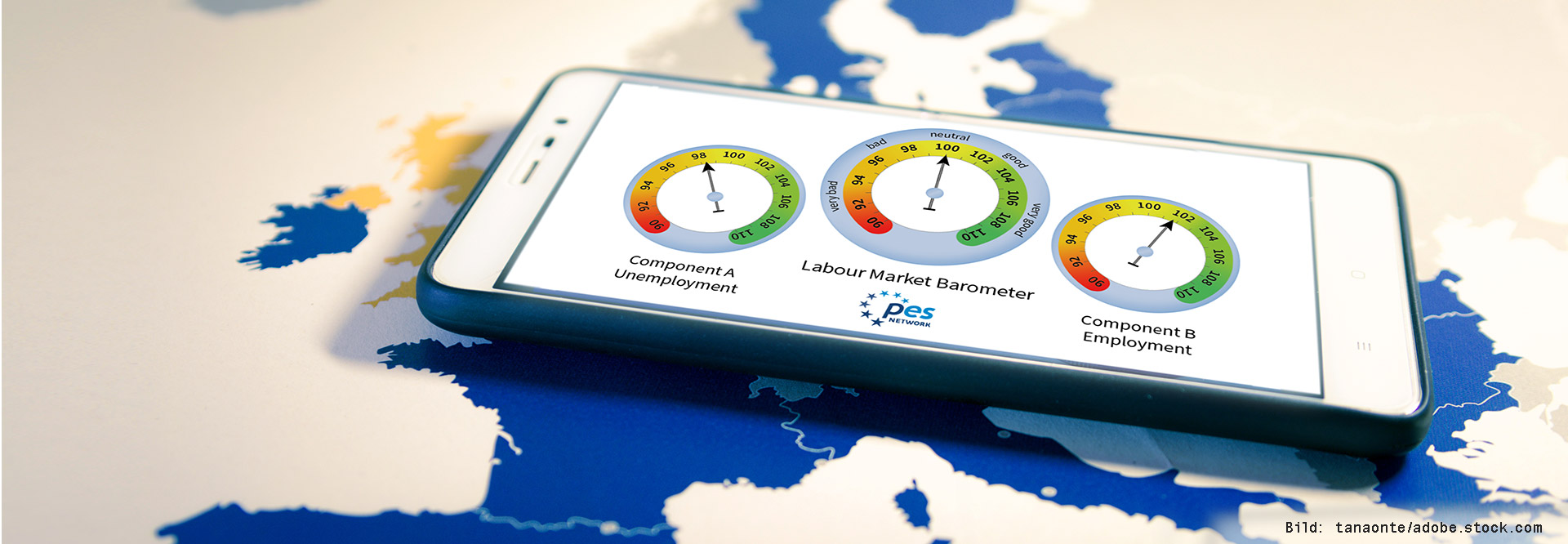
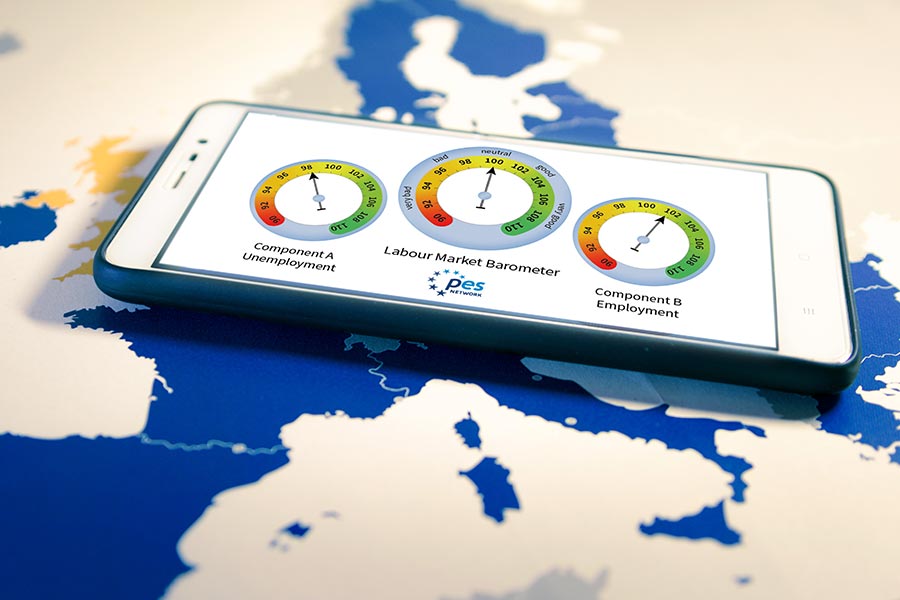
European Labour Market Barometer: European labour markets are losing some groundThe European Labour Market Barometer declined slightly for the third consecutive time in February.

19. February 2026
Navigating Motherhood: Endogenous Penalties and Career ChoiceThis IAB-Discussion Paper analyzes the interaction between fertility, child penalties, and career choices.

18. February 2026
Call for Papers: 7th Forum „Higher Education and the Labour Market“ (HELM)The HELM conference combines contributions with a general perspective on ‘Higher Education and the Labour Market’, with contributions on alternating focus topics.
13. February 2026
Video – Flight, family, work: The path into the labour marketA study based on interviews with 3,400 refugees shows that Ukrainian women enter the labour market much faster than other refugee groups.

28. January 2026
European Labour Market Barometer: European labour markets remain subduedThe European Labour Market Barometer dropped slightly in January.
22. January 2026
Video – New data shows: Germany is often just a stopoverWhy do so many plan to leave - and what could make them stay? Researchers at the IAB surveyed over 50,000 people - and the results are eye-opening.

15. January 2026
Minimum wage and job reallocation: The hidden role of financial constraintsThe introduction of Germany’s minimum wage in 2015 triggered large shifts in the composition and allocation of types of employment.

30. December 2025
The European Labour Market Barometer drops to 100 pointsThroughout the year, the European Labour Market Barometer was on a stabilizing course, but there was a slight setback at the end of the year.

18. December 2025
The Impact of the Minimum Wage on Initial Labour Market OutcomesThe minimum wage does not harm the education-to-work transition, but impacts the mix of both – firms and occupations in the labour market.
Gender Pay Gap
Women still earn less than men in Germany. According to calculations by the German Federal Statistical Office, the difference in gross hourly earnings in 2025 was 16 per cent on average across Germany without adjustment. Around two thirds of this pay gap, also known as the gender pay gap, can be attributed to structural differences between the genders. But even assuming comparable jobs, qualifications and employment histories, women earn around 6 percent less than men.
The reasons of the gender pay gap are just as numerous as the adjustments that need to be made to tackle the problem. Are there differences within Germany? And what action should be taken? This is shown by the IAB publications and projects on this topic.
Current events

12.3.2026
Mental Health Challenges Among Teachers: The Role of the WorkplaceThis study examines the role of schools as workplaces in generating heterogeneity in teachers’ mental health.
IAB-Colloquium with Ingo Isphording, PhD, Max Planck Institute for Behavioral Economics

19.3.2026
Refugee Inflows, Task Upgrading, Wages and Productivity in Turkey’s Dual Labor MarketThis paper studies how large-scale refugee inflows affect native workers, firms, and aggregate productivity.
IAB-Colloquium with Prof. Murat Kirdar, PhD, Koç University, Istanbul

26.3.2026
Vocational Education and Earnings Growth: Human Capital vs. Firm SortingThis paper examines how post-16 educational tracking into academic and vocational pathways shapes early-career earnings trajectories.
IAB-Colloquium with Assistant Prof. Dr. Sönke Matthewes, Utrecht University

16.4.2026
Working Hours, Workplace Hazards, and Health: The Long-Term Impact of the Eight-Hour DayThis study is about a nationwide policy trial from Sweden in 1920 that reduced the standard workweek from 55 to 48 hours.
IAB-Colloquium with Prof. Dr. Daniel Kühnle, Universität Duisburg-Essen

23.4.2026
Beyond the Chores: Mental Load, Gender, and CareersThis study investigates the often-overlooked "mental load" of domestic labor and its implications for gender equality and careers.
IAB-Colloquium with Assistant Prof. Gözde Corekcioglu, PhD, Ozyegin University

13.5.2026
The OECD Economic Survey of Germany 2025After a decade of strong export-led growth COVID-19, war in Ukraine and rising trade tensions have hit the German economy and emphasised the need to accelerate structural reforms.
IAB-Colloquium with Robert Grundke, PhD and Enes Sunel, PhD, both Organisation for Economic Co-operation and Development

18.6.2026
Technological Rivalry and the Allocation of Talent: Evidence from China’s College AdmissionThis paper studies how the U.S-China technology rivalry reshapes college admissions using data from China.
IAB-Colloquium with Prof. Lei Li, PhD, Georg-August-University Göttingen

23.6.2026 - 24.6.2026
7th Forum „Higher Education and the Labour Market“ (HELM)This year’s focus topic is ‘Intended and Unintended Consequences of Higher Education’.
Call for Papers

20.7.2026 - 21.7.2026
2nd Workshop on Imperfect Competition in the Labor MarketStudies addressing topics from a theoretical and/or empirical perspective for presentation at the workshop.
Call for Papers; IAB - LASER