


Total hits 17.329
-
Wegen der Corona-Krise können viele Beschäftigte nicht zur Arbeit kommen (Serie "Corona-Krise: Folgen für den Arbeitsmarkt")
Wanger, S. & Weber, E. (2020): Wegen der Corona-Krise können viele Beschäftigte nicht zur Arbeit kommen (Serie "Corona-Krise: Folgen für den Arbeitsmarkt"). In: IAB-Forum No. 06.05.2020, o. Sz.
-
Understanding ‘Don't know’ answers to survey questions
Purdam, K., Sakshaug, J., Bourne, M. & Bayliss, D. (2024): Understanding ‘Don't know’ answers to survey questions. An international comparative analysis using interview paradata. In: Innovation: The European Journal of Social Science Research, Vol. 37, No. 2, p. 219-241. DOI:10.1080/13511610.2020.1752631
-
Workforce composition, productivity and pay: the role of firms in wage inequality
Criscuolo, C., Hijzen, A., Schwellnus, C., Barth, E., Chen, W., Fabling, R., Fialho, P., Stadler, B., Upward, R., Zwysen, W., Grabska, K., Kambayashi, R., Leidecker, T., Nordström Skans, O., Riom, C. & Roth, D. (2020): Workforce composition, productivity and pay: the role of firms in wage inequality. (IZA discussion paper 13212), Bonn, 40 p.
-
IAB-Stellenerhebung 1/2020: Einbruch am Stellenmarkt im ersten Quartal
Kubis, A. (2020): IAB-Stellenerhebung 1/2020: Einbruch am Stellenmarkt im ersten Quartal. In: IAB-Forum No. 05.05.2020, o. Sz.
-
Self-selection of Asylum Seekers: Evidence From Germany
Guichard, L. (2020): Self-selection of Asylum Seekers: Evidence From Germany. In: Demography, Vol. 57, No. 3, p. 1089-1116. DOI:10.1007/s13524-020-00873-9
-
Back to the Norm? Compromises Between Gender-typical and -atypical Occupational Aspirations, Applications, and Vocational Training Occupations
Kleinert, C. & Schels, B. (2020): Zurück zur Norm? Kompromissbildung zwischen geschlechtstypischen und -untypischen Berufsaspirationen, Bewerbungs- und Ausbildungsberufen. In: C. Ebner, A. Haupt & B. Matthes (Hrsg.) (2020): Berufe und Soziale Ungleichheit (Kölner Zeitschrift für Soziologie und Sozialpsychologie. Sonderheft 1/2020), p. 229-260. DOI:10.1007/s11577-020-00668-1
-
Wo ist die Chance in der Krise? Das Corona-Virus und der wirtschaftliche Strukturwandel
Promberger, M. (2020): Wo ist die Chance in der Krise? Das Corona-Virus und der wirtschaftliche Strukturwandel. (Serie "Corona-Krise: Folgen für den Arbeitsmarkt"). In: IAB-Forum No. 04.05.2020, o.Sz.
-
Wie sich die Maßnahmen zur Corona-Eindämmung auf den Arbeitsmarkt ausgewirkt haben
Bauer, A. & Weber, E. (2020): Wie sich die Maßnahmen zur Corona-Eindämmung auf den Arbeitsmarkt ausgewirkt haben. In: Makronom No. 04.05.2020, o. Sz.
-
Jobkiller und Jobcreator?
Schneemann, C. & Zika, G. (2019): Jobkiller und Jobcreator? Welchen Einfluss hat die Digitalisierung auf unseren Arbeitsmarkt und die Wirtschaft? In: Informationen zur Raumentwicklung, Vol. 46, No. 6, p. 22-35.
-
The Polarization of Reality
Alesina, A., Miano, A. & Stantcheva, S. (2020): The Polarization of Reality. In: AEA papers and proceedings, Vol. 110, p. 324-328. DOI:10.1257/pandp.20201072
-
German labour market data – Data provision and access for the international scientific community
Müller, D. & Wolter, S. (2020): German labour market data – Data provision and access for the international scientific community. In: German Economic Review, Vol. 21, No. 3, p. 313-333. DOI:10.1515/ger-2019-0127
-
Guidelines for cost-effective use of SURE: Rule-based short-time work with workers’ consent and aligned replacement rates
Balleer, A., Gehrke, B., Hochmuth, B. & Merkl, C. (2020): Guidelines for cost-effective use of SURE: Rule-based short-time work with workers’ consent and aligned replacement rates. In: VOX No. 01.05.2020, o. Sz.
-
Seeking asylum in Germany: do human and social capital determine the outcome of asylum procedures?
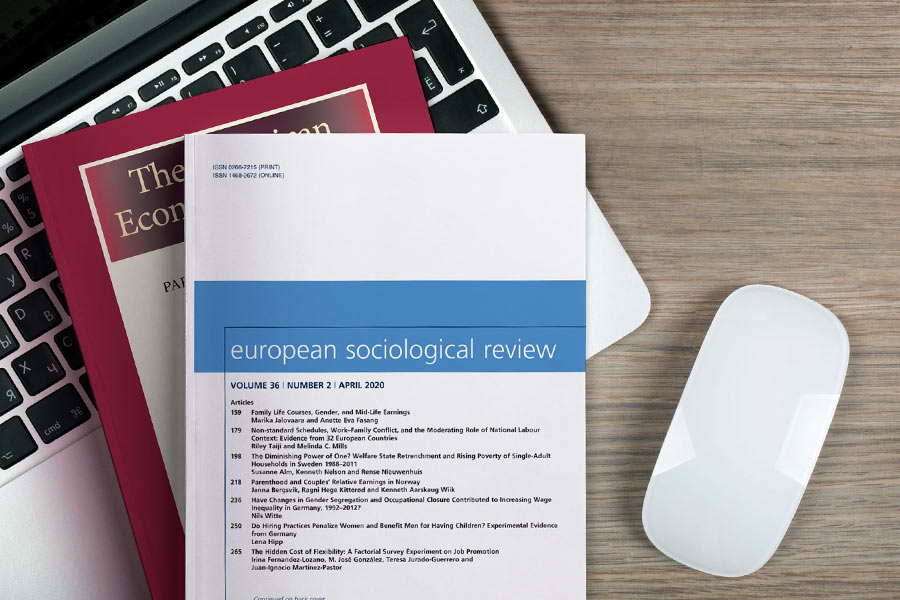
Kosyakova, Y. & Brücker, H. (2020): Seeking asylum in Germany: do human and social capital determine the outcome of asylum procedures? In: European Sociological Review, Vol. 36, No. 5, p. 663-683. DOI:10.1093/esr/jcaa013
-
Die Welt nach der Corona-Krise - solidarischer, digitaler, nachhaltiger?
Walwei, U. (2020): Die Welt nach der Corona-Krise - solidarischer, digitaler, nachhaltiger? (Serie "Corona-Krise: Folgen für den Arbeitsmarkt"). In: IAB-Forum No. 28.04.2020, o.Sz.
-
A data driven approach to understanding and handling non-response in the Next Steps cohort
Silverwood, R., Calderwood, L., Sakshaug, J. & Ploubidis, G. (2020): A data driven approach to understanding and handling non-response in the Next Steps cohort. (CLS Working Paper 2020/05), London, 34 p.
-
Minimum wage as a social policy instrument
Bruckmeier, K. & Bruttel, O. (2021): Minimum wage as a social policy instrument. Evidence from Germany. In: Journal of Social Policy, Vol. 50, No. 2, p. 247-266. DOI:10.1017/S0047279420000033
-
Evidence on job search models from a survey of unemployed workers in Germany
DellaVigna, S., Heining, J., Schmieder, J. & Trenkle, S. (2020): Evidence on job search models from a survey of unemployed workers in Germany. (IZA discussion paper 13189), 108 p.
-
Evidence on job search models from a survey of unemployed workers in Germany
DellaVigna, S., Heining, J., Schmieder, J. & Trenkle, S. (2020): Evidence on job search models from a survey of unemployed workers in Germany. (NBER working paper 27037), 108 p. DOI:10.3386/w27018
-
Do neighbors help finding a job?
Jahn, E. & Neugart, M. (2020): Do neighbors help finding a job? Social networks and labor market outcomes after plant closures. In: Labour Economics, Vol. 65, p. 1-15. DOI:10.1016/j.labeco.2020.101825
-
Do job creation schemes improve the social integration and well-being of the long-term unemployed?
Ivanov, B., Pfeiffer, F. & Pohlan, L. (2020): Do job creation schemes improve the social integration and well-being of the long-term unemployed? In: Labour Economics, Vol. 64. DOI:10.1016/j.labeco.2020.101836